That Feeling When You Get Stuck.
Remember the first episode of Jay’s Musings, when I said I was starting over? Well I did, and I made it ~28,000 words, and now I’m moving towards a point where I’ll be stuck soon.
How do I know this? I sped along in mid-December, churning out around 1k-2k (or more) words a day for about a week and a half. Then it slowed down considerably. The holidays rolled in and I was busy, and I also couldn’t figure out what to write. I kept moving on as best I could, but I left behind 4 sequential, unfinished chapters.
Because of the ADHD, well, really the AuDHD, I have pretty linear, black and white thinking. When I hear the advice of write the scene you really want to write, even if it’s not the next scene, I struggle. I have to go in order. You write the beginning first, middle second, and then the end. And while intellectually I agree that’s probably a good idea at times, emotionally that is a hard rule I have to follow.
It’s only a hard rule because I say it is, but changing that rule means re-wiring my brain and neural pathways. Our nervous system is wired to seek out actions that deliver a little hit of dopamine, the brain’s reward chemical. If we do something that makes us feel good, we’re likely to do it again. Writing a novel in order feels good to me, so it’s something that’s being rewarded and reinforced in my brain.
Repeated actions can form habits. This information is stored in the basal ganglia, where we develop emotions and memories.1 It’s important to note, however, that the prefrontal cortex is where conscious decisions are made. The basal ganglia is not something we have conscious control over. This could be why habits can be so hard to break.1
As I’m writing this, I’m asking myself is my pattern of starting something new and then getting stuck and starting over a habit, or something greater that falls under the ADHD struggle?
Research into motivation suggests that actions can either be goal-directed or habitual, and these each have distinct neural signatures in the brain: “goal-directed” being associated more with the prefrontal cortex and caudate (part of the basal ganglia), and “habitual” being associated more with the putamen (another part of the basal ganglia) and the motor cortex (in the frontal lobe).2 There is research to suggest there are structural differences in these brain regions between those with ADHD and those without.
For example, ADHD is associated with reduced gray matter volume in the caudate, expansion of the posterior putamen, and aberrant connectivity in the ventromedial prefrontal cortex (vmPFC) and anterior cingulate cortex (ACC).2
There may be reward-related abnormalities, in that those with ADHD display impairments in learning from, interacting with, and processing rewards.3 Other studies have have shown that children and adults with ADHD present heightened delay aversion, such that they choose immediate, less valuable rewards over delayed yet larger rewards.2
Back to my question, is this a habit or not? A habit is…
…a routine, behavior, or even cognitive process that starts spontaneously but is repeated automatically as a result of prior experience.4
Habits rely on context. They are strengthened by repetition and association with cues from the surrounding environment. Their expression is depending on such relevant cues.4 Habits tend to be pretty inflexible, since there is little cognitive input required. They are performed quickly and automatically.4
Versus, goal-directed behavior is performed based on predicted or expected outcomes, which allows for adaptation to changes in context.4
I would say my main cues of this habit’s expression are:
- Daily or weekly word count drops dramatically week-over-week
- I start leaving chapters unfinished because I’m not sure what to write
- The story as a whole feels “off” but I can’t put into words why
So if my goal is write a novel, but my habit is to stop, re-think, and scrap said novel shortly after I get stuck… What’s a writer to do?
I have to break the cycle, or…
(Cue Linkin Park’s Breaking the Habit)
This is incredibly daunting at first glance. You mean I have to rewrite my neural pathways, the things I don’t have conscious control over? There’s no quick, easy fix either? It’s just literally doing the thing over and over again until it becomes automatic?
Ugh.
But first, I need to make this new habit more tangible, more understood. I don’t want to push myself to slog through something uncomfortable, but I also don’t want to give up and let this old habit (of scrapping every partially-finished novel the moment it becomes uncomfortable and hard to execute) win. There’s got to be a middle ground.
So I’m trying out some things. First, I “reverse outlined.” I wrote short, 1-3 sentence synopses for all chapters in my novel thus far to get a good bird’s eye view of the story. Next, I typed up a basic plot grid with those synopses as they related to the 3-act structure I’m using, as well as a few other details.
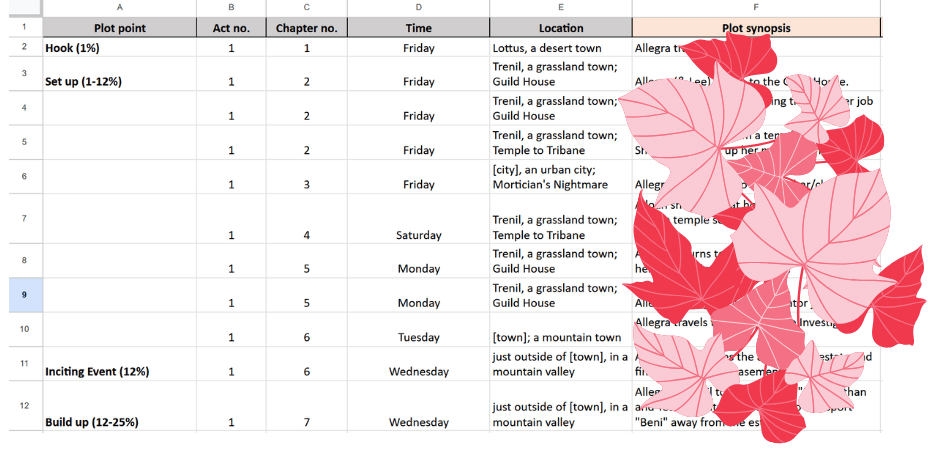
You can see in the location column that my specificity becomes more vague the deeper into the book I get, with just [placeholders] listed for locations I don’t have named yet. I’m up to Chapter 15, but Chapters 11-14 are still unfinished as far as a First Draft is concerned.
I’ve never used a plot grid before and only just recently learned of this type of plotting. I consider myself a Plantser – I plot and “pants” my way through. Over the years I’ve discovered that my plotting needs to be very specific in its level of detail. I can’t have too much of it. But I need some level of detail plotted out to follow or else I’ll wade around in my writing moving in no real direction, get frustrated, and give up.
My compromise is usually to write out a short synopsis of each plot point according to K. M. Weiland’s 3-Act structure, but no more than 3-5 sentences, and everything is pretty vague. If there’s a conversation that is supposed to happen, I’ll simply put that the “two (or more) characters talk”, with very little other context. This gives the Pantsing side something to figure out in the moment while the Plotting side is content knowing that a conversation is going to happen in the given plot point. But that’s all I really do these days. I’ve tried detailing out each chapter and/or each scene beat and it’s too much detail. I hyperfocus the plotting part of it, and when it comes time to actually write, there’s nothing new for me to discover anymore, and I get bored with the project before it has a chance to take flight.
It works for me, but I’ve never had a solution for when I get stuck. Ironically, my day-job title is a Solutions Consultant, so I’m putting on my work-hat for this task and asking myself some questions:
- What do I feel isn’t working, specifically?
- What do I feel is working, specifically?
- Do any areas feel like the pacing is rushed?
- Do any aspects feel like I’m forcing something to happen for the sake of the plot, or just because I want the thing to happen, versus what is realistic and intuitive to the plot at large given the characters I’ve created?
While I’m not going to list any answers to the above on this blog, just typing out the questions is already got me thinking and feeling a little more comfortable with the discomfort of being stuck. I’m hoping this can be the first real step in creating this new habit, one that finds a balance between pushing myself while still respecting my time and energy.
Phew, this was a long one! Thanks for sticking with me. Let me know what kinds of solutions you have when you feel stuck in your own projects.
References
1 https://www.healthline.com/health/the-science-of-habit#1
2 Ceceli AO, Esposito G, Tricomi E. Habit Expression and Disruption as a Function of Attention-Deficit/Hyperactivity Disorder Symptomology. Front Psychol. 2019 Sep 3;10:1997. doi: 10.3389/fpsyg.2019.01997. PMID: 31551864; PMCID: PMC6733985.
3 Ceceli AO, Myers CE, Tricomi E. Demonstrating and disrupting well-learned habits. PLoS One. 2020 Jun 12;15(6):e0234424. doi: 10.1371/journal.pone.0234424. PMID: 32530930; PMCID: PMC7292414.
4 Mendelsohn AI. Creatures of Habit: The Neuroscience of Habit and Purposeful Behavior. Biol Psychiatry. 2019 Jun 1;85(11):e49-e51. doi: 10.1016/j.biopsych.2019.03.978. PMID: 31122343; PMCID: PMC6701929.

Leave a comment