Before I started on this article, I sat staring at the blinking cursor of my empty Word document for at least 15 minutes. And while that might not seem like a long time, it is for me. You see, I have hyperactive ADHD. My mind and my body are always in a “go-go-go!” mode. I struggle to sit still and focus on one thing at a time. I like to think I’m extra sensitive to stimuli and have a hard time filtering out unnecessary stimuli in order to focus.
All I know for certain is that it’s exhausting.
If anything I wrote in my first post of this series, Writing with ADHD: an Introduction, has resonated with you, then the exhaustion experienced with this disorder may also resonate. This exhaustion is why today’s article is so important. This isn’t about how you write a novel while having ADHD (I’m still figuring that one out). Today we are talking about one of Rosanne Bane’s Three Habits to tackle writer’s block, what she calls “writer’s resistance.” And while Bane’s book Around the Writer’s Block: Using Brain Science to Solve Writer’s Resistance hasn’t specifically mentioned neurodiversity of any kind (thus far, I haven’t finished the book yet), I believe there is still much to be learned and much that can be tailored to fit a neurodiverse writer.
If you haven’t guessed already, the first habit Bane encourages us to cultivate is called Process.
Process involves doing something fun that puts you in the creative flow. You do Process just for the sake of doing it; it’s creative play for play’s sake. [p.40]
Bane mentions specifically that Process is not about the outcomes. So when I tried the exercise in her book about identifying different kinds of Process I already had in my life, my list was short. This was a few months ago when I completed this exercise, and sadly, the list has not grown in length.
As I’ve mentioned before, I live in America where productivity is king. Outcomes from time spent productively are prized. “Play for play’s sake” is not valued in the mainstream society that I’m exposed to. And because I’ve been exposed to this for most of my life, it’s a hard lesson to unlearn.
What are examples of Process? Banes lists several:
- Keeping a dream journal
- Freewriting
- Listening to music
- Coloring in a coloring book
- Drawing mandalas
- Making collages
- Scrapbooking
- Sketching
- Painting
- Playing with clay or Play-Doh
- Taking photos
- Fooling around with an instrument
- Singing
- Daydreaming
- Dancing
- Knitting
- Watching people on the bus
She explains that…
Any kind of creative play that appeals to you, captures your focus, and allows you to get lost in the doing without fretting about the outcome is a good choice for Process. [p.42]
If I had to rapid-fire my choices for Process from my own hobbies list, I’d choose crochet and coloring. I wouldn’t call myself exceptionally skilled in crochet, but I can read a pattern (executing it is another thing altogether), and I know most of the American abbreviations. I also rarely finish my crochet pieces, and that’s okay. Choosing the yarn and the hook and starting the project are fun for me. It doesn’t really matter what the end product is because I have no expectation that I’ll finish the project. Crochet is calming and something to keep my hands busy so that I can pay attention.
Recently I was gifted a set of 100 markers and a sketch book by a dear friend of mine. Little does she know, this is the perfect gift for this time of the year. You see, I wrote the first part of this article months ago, up until this specific paragraph. And then the ADHD kicked in. And then the sun went away and I got sad. Seasonal Affective Disorder hits me hard in the winter. All I want to do is crawl into bed and sleep. I’m exhausted, moody, and listless every day. For once, I’m not in “go-go-go!” mode, but that doesn’t mean I can focus any better.
Which is why Process is more important than ever during this time.
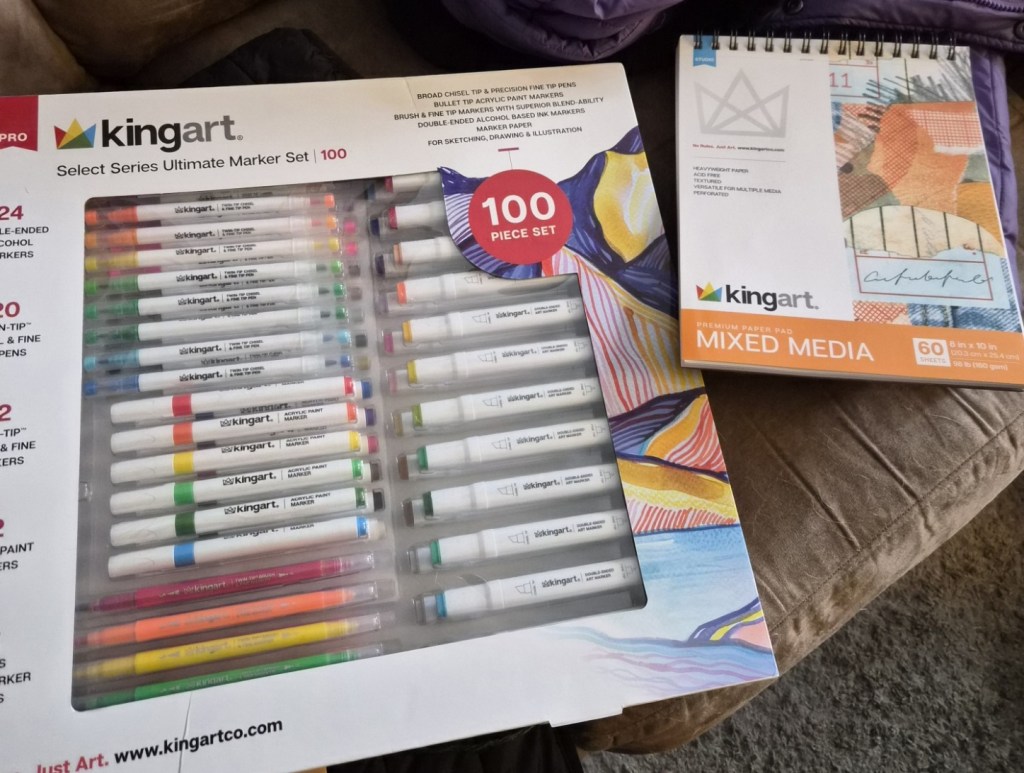
While I’m not much of a sketch artist, I do love to color, and I’ve been lacking a good set of markers, so this is such an amazing gift.
I haven’t been writing. I’ve barely been daydreaming. I think now is the time to really engage in Process, to reset, to give my creative muse some tea so she can sing again when the time is right.


Leave a reply to noisilytimetravel2939fdae1d Cancel reply